 En
En
 en
en  vi
vi  zh
zh  es
es  th
th  ja
ja  pt
pt  ms
ms  ru
ru  fr
fr  de
de  ar
ar  id
id 
News
Follow us to stay updated on the latest industry trends.
For businesses looking for a container house manufacturer in China, trendy container houses offer a practical way to create attractive commercial spaces without the long construction cycle of conventional buildings. Designed for fast installation, flexible relocation, and visual customization, these modular structures are becoming increasingly popular for coffee shops, bubble tea stores, creative retail spaces, camping facilities, tourism projects, and creative parks.
Unlike traditional construction, a modern container house can be prefabricated at the factory and transported to the project site for rapid assembly. Once the foundation and basic utilities are ready, the structure can be installed and connected to water and electricity with much less site work. For entrepreneurs and commercial developers, this means a faster route from site selection to actual operation.
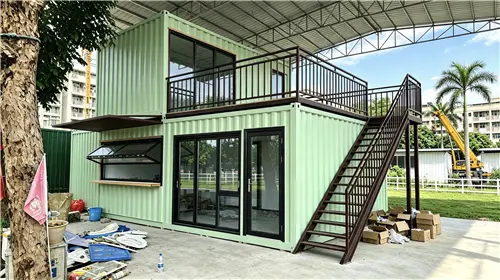
The popularity of trendy container houses is not simply about appearance. They combine several practical advantages that are difficult to achieve with conventional buildings: distinctive design, rapid deployment, mobility, modular expansion, and controlled construction processes.
For a new coffee shop or retail business, opening speed matters. Every additional week spent on construction can delay revenue generation and increase site-related expenses. Factory production allows most structural and finishing work to be completed before transportation, reducing the amount of work required at the destination.
At the same time, the modular structure makes these buildings suitable for projects where the site may change in the future. A container shop can potentially be dismantled, transported, and reused rather than becoming a permanent structure that is difficult to relocate.
For businesses that need a combination of branding, flexibility, and practical construction, a modern container house solution provides a more adaptable alternative.
For commercial projects, the building itself can contribute to customer acquisition.
A traditional temporary building may focus mainly on functionality, while a trendy container house can be designed as part of the brand experience. Custom exterior finishes such as creamy white wood grain, colorful combinations, modern metal panels, and other decorative treatments can create a distinctive visual identity.
Large floor-to-ceiling windows can increase natural lighting and make the interior more visible from outside. External service windows are especially useful for coffee shops, beverage stores, snack outlets, and small retail businesses because customers can place orders without entering the building.
For tourism destinations and camping sites, outdoor seating areas, terraces, balconies, and second-floor platforms can further improve the overall appearance. A well-designed container building can naturally become a photo spot, which is particularly valuable for businesses relying on social media exposure.
This is where customization becomes important. The goal is not simply to make a container look attractive, but to make the building fit the business model, site environment, customer flow, and brand image.
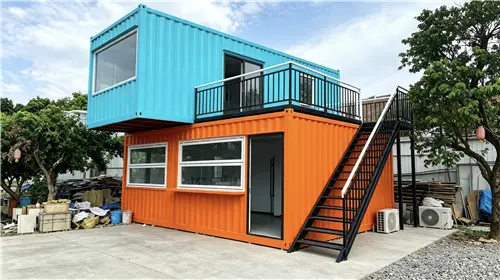
One of the biggest advantages of modular container construction is the separation between factory production and site preparation.
While the project foundation and utility connections are being prepared, the container structure can be manufactured at the factory. Structural components, wall systems, insulation, doors, windows, electrical components, and interior finishes can be completed according to the selected configuration.
Once production is completed, the modules can be transported to the destination and installed using lifting equipment.
This approach reduces the amount of traditional construction work required on site. Compared with projects that depend heavily on on-site masonry, framing, interior finishing, and decoration, factory-prefabricated buildings can significantly shorten the overall project schedule.
For commercial projects such as pop-up stores, tourism facilities, seasonal businesses, and temporary retail locations, shorter installation time can be particularly valuable because the business can begin operations sooner.
A major advantage of containerized modular construction is that one standard configuration does not have to fit every project.
Suzhou Guxin can provide different structural combinations according to project requirements. Options can include single-story units, two-story buildings, cantilevered structures, and multi-container combinations.
For example, a small coffee shop may only require one compact unit with a service window and outdoor seating area. A larger commercial project may combine several modules to create a dining area, storage room, kitchen, office, or customer lounge.
Two-story configurations can also make better use of limited land. The ground floor can be used for retail or service functions, while the upper floor can accommodate offices, storage, accommodation, or additional customer space.
This modular approach allows developers to start with a practical configuration and expand the building when project requirements increase.
A visually attractive building still needs to withstand real outdoor conditions.
The primary structure of a container house is generally based on a steel frame designed for structural stability and long-term use. Suzhou Guxin uses weather-resistant steel and controlled manufacturing processes to improve structural integrity, waterproofing, and durability.
The building can be configured according to different climatic and environmental requirements. This is important for projects located in areas with strong winds, significant temperature changes, or frequent rainfall.
Insulation is another important part of the building system. Depending on project requirements, rock wool or silica wool insulation materials can be selected. Fire-performance requirements can also be addressed through appropriate insulation and wall system configurations.
Suzhou Guxin's rock wool insulation boards are manufactured from basalt through a high-temperature melting process and are designed to provide fire resistance, water repellency, moisture resistance, and sound insulation. These properties make them suitable not only for container buildings but also for cold storage facilities, industrial plants, and commercial buildings.
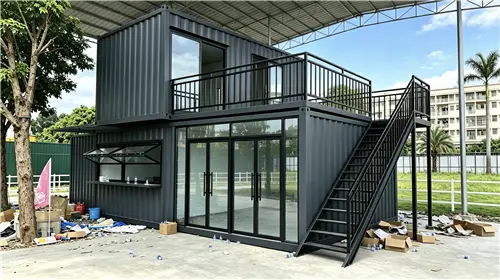
Although container houses are often associated with temporary construction sites, their applications have expanded considerably.
Today, modular container buildings can be used in commercial, residential, public, and special-purpose projects.
Typical commercial applications include:
· Coffee shops
· Bubble tea and beverage stores
· Pop-up retail stores
· Mobile offices
· Hotels and accommodation facilities
· Showrooms
· Camping facilities
· Tourism service stations
For commercial operators, the ability to customize appearance and internal layout makes modular buildings suitable for both short-term and long-term projects.
Containerized buildings are also widely applicable to construction camps, security checkpoints, school classrooms, medical clinics, temporary offices, and project management facilities.
Construction companies can deploy standardized accommodation and office units at different project sites and relocate them when a project is completed.
For residential projects, modular units can be configured as temporary homes, holiday houses, apartment-style buildings, and social welfare housing.
They can also serve specialized functions such as emergency rescue command posts, laboratories, and other temporary facilities where rapid deployment is important.
For overseas buyers, choosing a China container house factory involves more than comparing product specifications. Packaging, transportation, inspection, loading efficiency, documentation, and communication all affect the final project experience.
Suzhou Guxin has experience in international production and export, providing services covering manufacturing, inspection, packaging, and ocean transportation coordination.
For overseas distributors and project contractors, shipping options can be planned according to the project requirements. Products can be shipped as complete units or in suitable configurations for container transportation. A 40-foot shipping container can accommodate multiple units or components depending on the design and packing method.
This is particularly useful for distributors purchasing multiple units for different projects. Standardized manufacturing and modular structures also make repeat orders easier to manage.
Buyers can explore the available container house products and configurations before discussing specific project requirements with the manufacturer.
Suzhou Guxin Steel Structure Engineering Co., Ltd. was established in 2016 and focuses on the design, manufacturing, and export of modular container buildings and related building materials.
Its product development covers three core areas: fireproof rock wool insulation boards, modular container houses, and prefabricated color steel cladding.
The company's production approach combines standardized manufacturing with project-specific customization. Whether the requirement is a compact retail unit, comfortable living space, construction camp, multi-story commercial building, or specialized modular facility, the design team can adjust the configuration according to the intended application.
The company also follows green building principles by supporting the reuse and renovation of suitable container structures while continuing to develop new modular building systems. Compared with traditional construction, factory-prefabricated production can reduce on-site work and shorten project cycles.
For international buyers searching for a reliable container house supplier in China, this combination of manufacturing capability, customization, export experience, and modular technology can simplify project implementation.
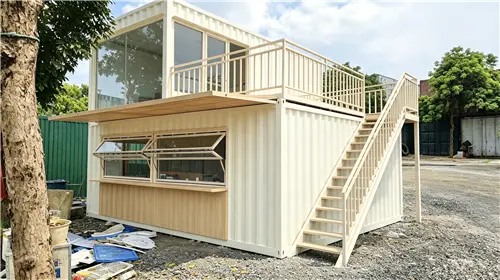
A modern container house is no longer simply a temporary box placed on a construction site. With thoughtful design, it can become a coffee shop, retail store, accommodation unit, office, tourism facility, or complete multi-unit commercial space.
Its value comes from the combination of factory prefabrication, rapid installation, flexible configuration, durable steel construction, insulation options, and customizable appearance.
For entrepreneurs, modular buildings can provide a faster way to launch a new location. For tourism operators, they offer flexible facilities that can adapt to changing site requirements. For developers and distributors, standardized production and international shipping make multi-unit procurement easier to manage.
As commercial spaces continue to demand faster deployment and more flexible use, trendy container houses are becoming a practical building option rather than simply a design trend. With professional engineering, appropriate material selection, and reliable factory production, they can provide a durable and adaptable foundation for a wide range of projects.